The Project

The extraordinary endurance of the human species

The 0 to 100 project is an ambitious and meaningful endeavor. Sedentary lifestyles pose a real daily threat to all human beings, and this study aims to demonstrate, through an extraordinary project, the health benefits of high-dose physical activity made possible by a dream: completing the CCC.® !

The project in brief:
Participants
40
20 men, 20 women

100km

Ultimate goal: the CCC® in Chamonix.
18
Month
transformation

Goals

  • To get 80% participants to become finishers of a 100km ultra-trail during the CCC® in Chamonix in August 2027
  • To demonstrate the spectacular benefits of intense physical activity on physiology (endurance, muscle quality, strength and muscle power) and all indicators of mental and physical health
  • To demonstrate that human beings, all human beings, even the most sedentary, are “Born to run”

Schedule

  • Personalized training sessions with a coach
  • Monitoring of physiological and biomechanical variables during training and during the final 100 km
  • Regular gatherings for "shock weekends" with all participants
  • Assessments with laboratory tests every 5 months at the Regional Institute of Sports Medicine and Engineering (IRMIS) in Saint-Étienne to monitor participants' transformation

Impact

By transforming sedentary people into ultra-trail runners, this study is not limited to a sporting challenge; it aims to demonstrate the profound and measurable impacts of physical activity on health:
  • Better physical and mental health
  • Transformation of muscle and cardiorespiratory system characteristics
  • Better sleep, less inflammation, less daily fatigue
  • Stress reduction, positive effects on mood and anxiety

The Scientific Study

We know that physical activity is beneficial for health, but to what extent? The 0 to 100 study aims to precisely quantify the transformations of the body and mind through a rigorous scientific protocol, from the first training session to the final ultra-trail.
observation

Sedentary lifestyles: a major societal issue

A sedentary lifestyle is now one of the biggest risk factors for health. Lack of physical activity is directly responsible for millions of deaths each year, significantly increasing the risk of chronic diseases. The conclusion is undeniable: inactivity kills.

57%

Some French people have no activity or insufficient physical activity.

3.7M

of deaths worldwide each year are linked to insufficient physical activity.

99,98%

The proportion of its history in which the human species has been active.

50% of the population is not sufficiently active
Diagnosis

Sedentary lifestyle as an invisible threat

If physical inactivity kills, it is because it acts silently, by progressively weakening the body and mind. A sedentary lifestyle promotes the development of cardiovascular, metabolic, and mental diseases, drastically reducing life expectancy and quality of life. Yet, this danger often remains underestimated because its effects are slow and invisible in the short term. The consequences are dramatic for the health of the population, but also economically for our healthcare system.

Solution

Measuring the impact of physical activity on health

Physical activity is a powerful tool for preventing disease and improving health. The 0 to 100 study aims to to precisely quantify these effects by following, through rigorous metabolic, physiological and biomechanical analyses, the evolution of participants starting from scratch and subjected to training of such intensity and duration that they make this study a unique project in the world.

Les bénéfices de l'activité physique sur la santé
The health benefits of physical activity, infographic Le Monde
Protocol

Measuring the transformations

We know that physical activity is beneficial for health, but with this study, we will precisely quantify its effects on the body and mind, by analyzing each transformation in our participants.
Laboratory monitoring and monitoring during the final 100 km
IRMIS assessments every 5 months
Comparison of adaptations between the sexes
Learn more

Parameters studied

To gain a deeper understanding of the effects of physical activity, the study tracks a wide range of physiological, biomechanical, and cognitive indicators. Each parameter is measured at different stages of the program to observe participants' progress and quantify the benefits of movement.
  • Endurance
  • The quality of muscle tissue
  • Sleep
  • Muscle strength and power
  • Energy efficiency and the biomechanics of the stride
  • Insulin resistance & inflammation
  • Autonomic Nervous System
  • Body composition
  • Cognitive function
  • Quality of life and fatigue
  • Balance & flexibility
Planning

A structured path for participants

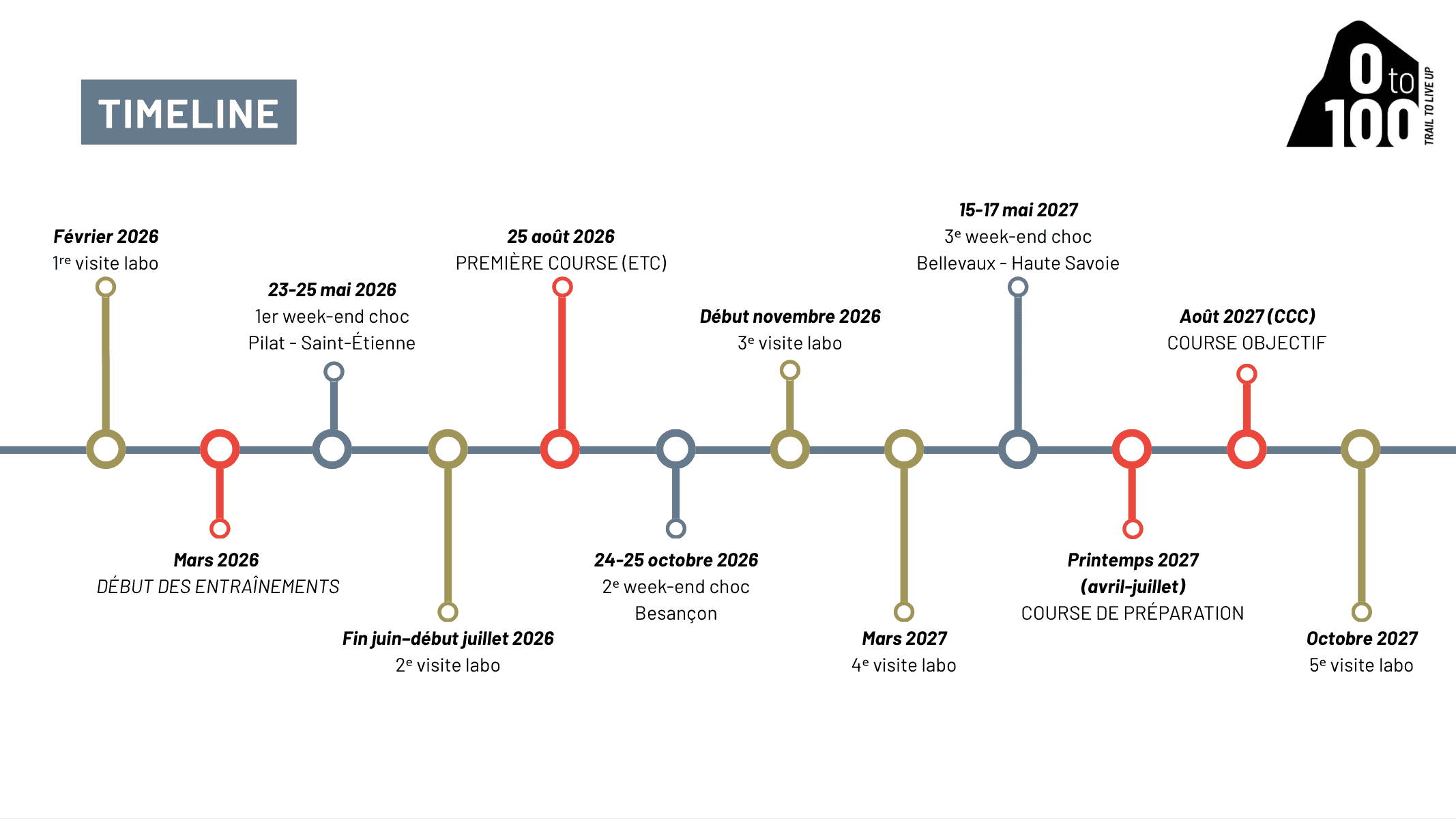
The study follows a rigorous 18-month progression, combining training, medical monitoring, and scientific analysis. Below are the key stages of this transformation, from participant selection to the finish line of the ultra-trail.
February 2026
Inclusion visit
June 2026
Visit #1
August 2026
ETC®
September 2026 to Summer 2027
Visit #2-3-4
End of August 2027
CCC®
October 2027
Visit #5
Inclusive approach

To each their own Ultra

Because every challenge is unique, the 0 to 40 project, while not a scientific study, is being conducted in parallel with the 0 to 100 project. It will allow those who cannot participate in a 100km ultra-trail due to illness or disability to prepare for "their" ultra while benefiting from the same medical and athletic support: the 40km of the MCC®. The goal: to make health through exercise accessible to all in an inclusive project.
  • An alternative: the 40km Martigny-Combes-Chamonix race (MCC®)
  • Open to people with chronic illness or disability
  • A Sport-Health challenge to encourage inclusivity and access to sport for all

Our Values

Commitment, endurance, perseverance, courage, pushing beyond one's limits, ecology, the environment, team spirit and cohesion, performance, physical and mental well-being are values that carry meaning and that we wish to highlight through this project.